It’s been rough trying to get the next piece out, but I think I’ve got something worth writing a little bit on. Hope it’s enjoyed.
Revolver Fantasy and the Fake 1920s
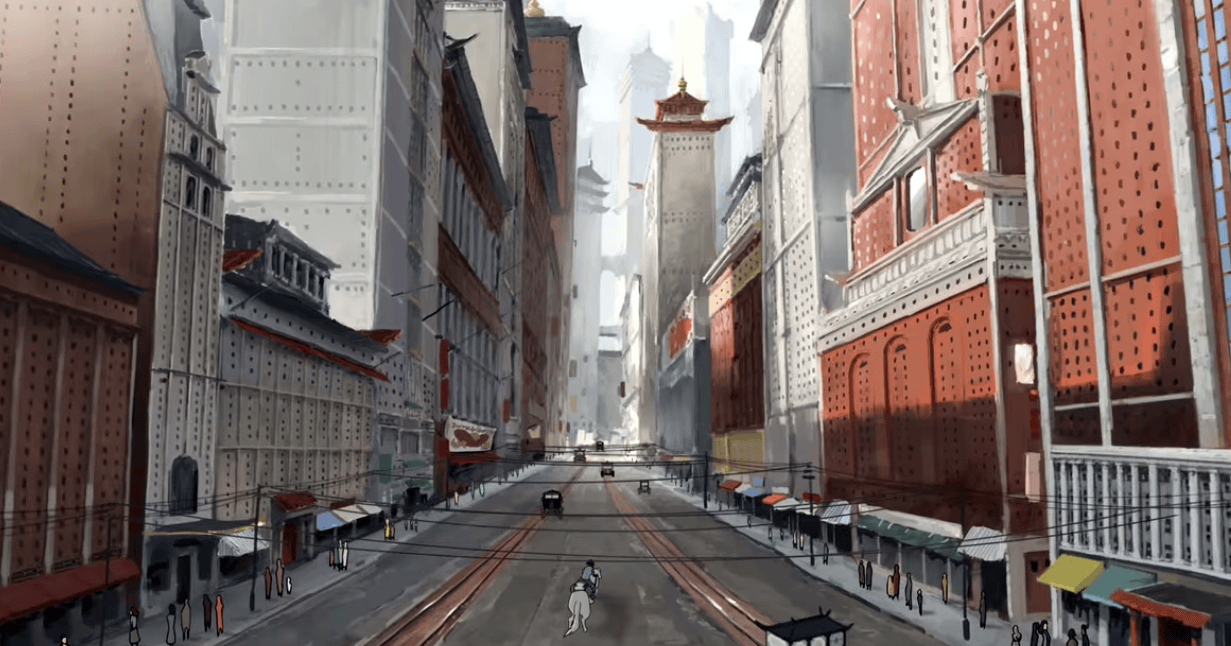
Revolver Fantasy, or Fake 1920s, are blanket terms I using to refer to a specific genre that I’m a big fan of. The most recent example I’ve come across of this is found in a children’s show, The Legend of Korra. I started it years ago and never finished, but decided to rewatch it now that I’m considerably older. The first thing that struck me was the animation for the fights, how brutal and cool they looked, but the second thing was what set the backdrop for the kicks and punches from Korra, our main character.
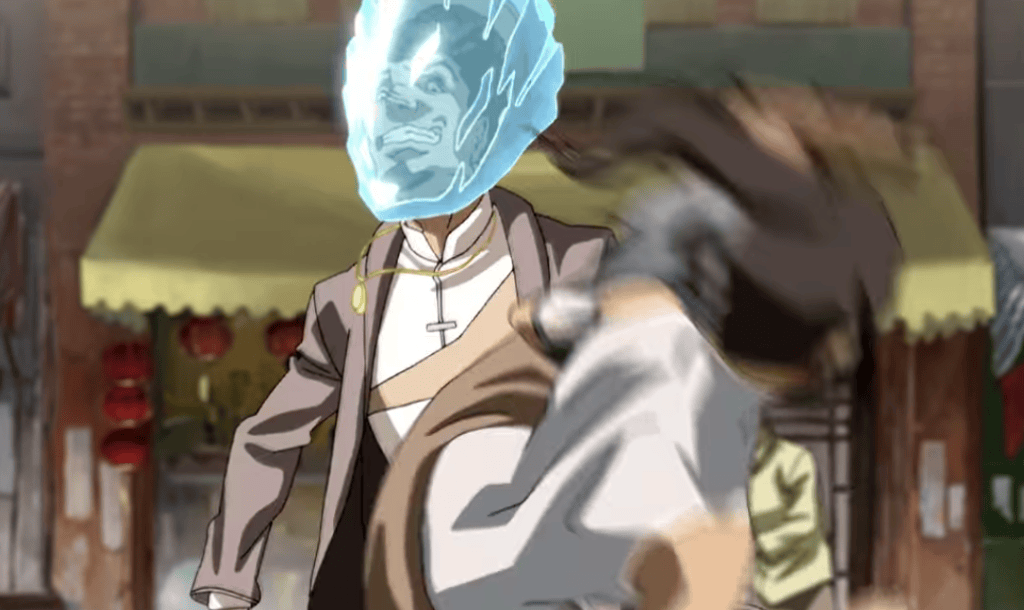
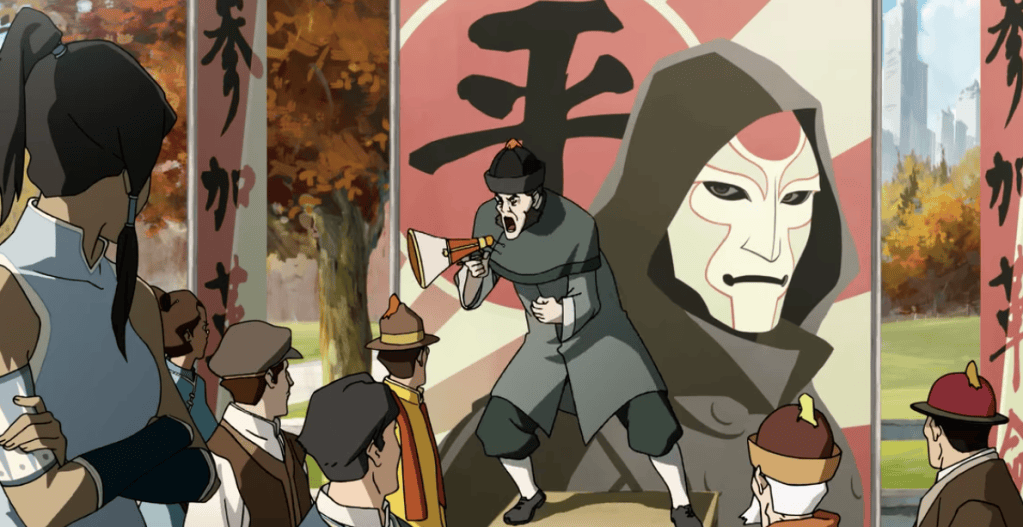
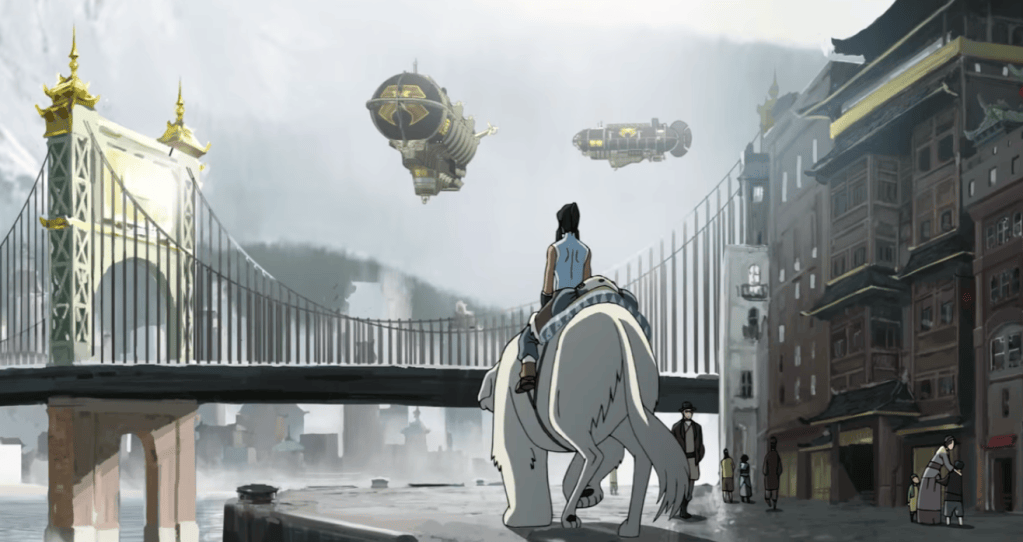
What I’m referring to is the design for the setting of this episode, a place called Republic City. Republic City is a pretty great example of Fake 1920s in action for a specific reason, the blending of fantasy and dated technology. Republic City is a city, yes, but one straight out of an old Batman comic. There are old-fashioned cars that look like Model T Fords and blimps in the air, along with giant, iron-wrought ships. There’s even old-fashioned political agitation, a guy preaching on a stand about injustice and the common man in a scene straight out of a socialist fantasy.
However, as you saw above, there’s also elemental magic and martial arts, where dudes get kicked in the face and throw fireballs at each other. These together give us Fake 1920s. Republic City is special, further, in that the metropolis draws inspirations from what I think is East Asia. My next example of Fake 1920s is rooted mainly in the West, while what’s shown in Korra, rather, is a blend of both Asian and European aesthetics or ideas from the early 20th Century.
A better, or more professional name for this concept is “Revolver Fantasy”, a term I believe I’m coining by writing this down. The name comes from a fantasy world called The Grishaverse created by Leigh Bardugo. Bardugo’s series are similar to Korra in that they are geared towards younger readers, but are no less interesting for it. Within the Grishaverse, characters fight their way through fictionalized versions of Europe where guns flash and magic slices in equal amounts.
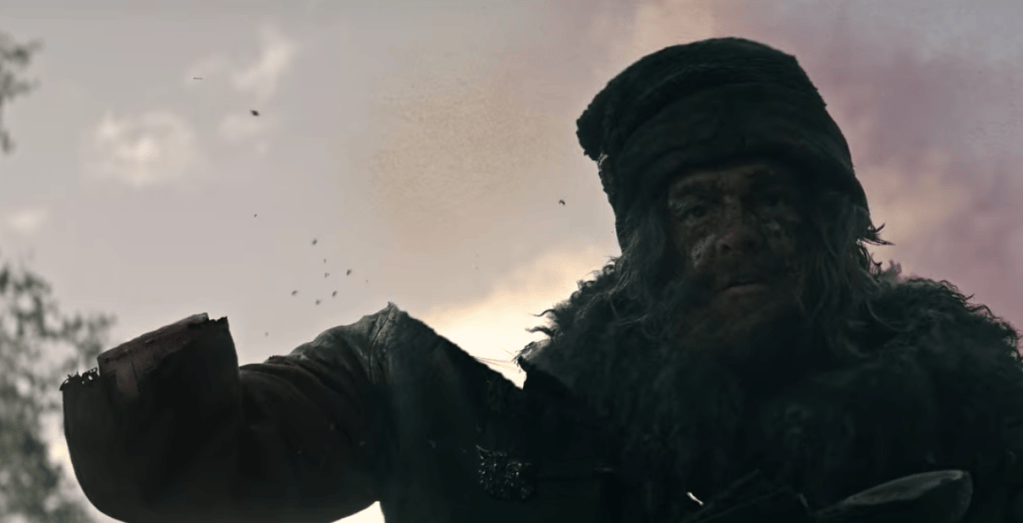
We see this in both the novels and the television adaptation – while there are those that can cut people in two with the wave of a hand, there are others who need to rely on more mundane weapons. This is best exemplified by the character Jesper Fahey, a criminal who is famous for the use of his handguns. That magic mixed with metal gives us the name of our genre – Revolver Fantasy.
This is a very interesting but poorly defined genre of fiction, and I think it’s a concept worth keeping in mind when you start browsing Netflix or Indigo for your next escape.
We Back
I didn’t write on this site for two full years – not sure exactly what the end and start dates were, but it’s certainly been a while. I was taken with the idea of needing to write something down, so I guess I’m back, hopefully for a little while longer.
What We Can Learn From History (Except The Boring Bits)
There’s a very old saying; “Those that do not learn from history are doomed to repeat it.” Now, this is applicable both in the average high school classroom and in the briefing room of the Pentagon. I would say that failing a class isn’t quite as bad as starting nuclear war, though I know some people who would disagree.
But in all seriousness, not too many people know about what came before us, nor do they care, writing off history as nothing but boring facts spouted from the mouths of teachers or other adults. But still, I think that it’s both important, and the source of the best stories that we may ever come across. Now, as the old saying goes (I’m full of those, by the way), “Truth is stranger than fiction,” and that’s true for a simple reason: Fiction needs to sound real.
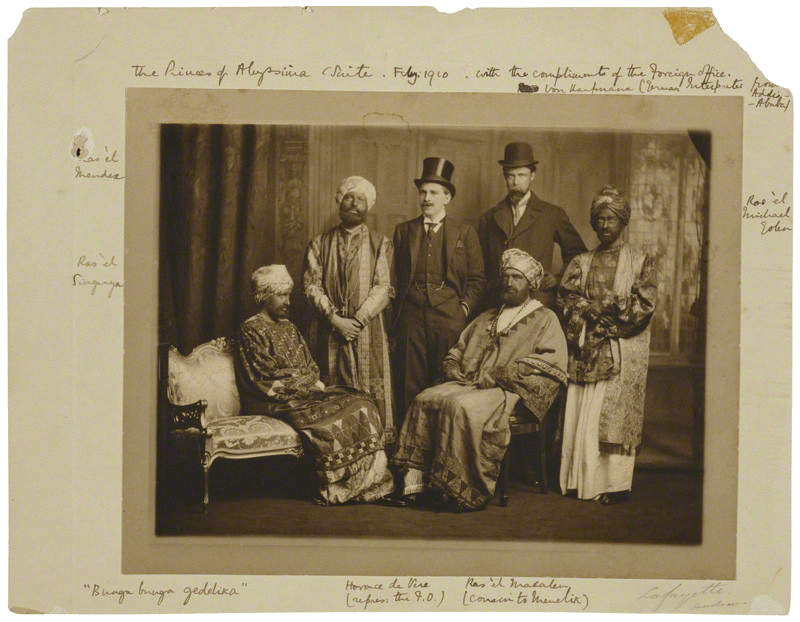
Now, here’s probably the best example: Virginia Woolf is many things; an author, a known feminist icon and a not so well known anti-semite. But something that most people probably don’t know about her is that time that she and her mates impersonated the Abyssinian (Ethiopian) emperor and his family in front of the British Navy’s submarine killing ship.
How it went is the way most days start: Virginia woke up, had a hearty breakfast of kippers and toast, and set off with her friend Horace de Vere Cole, a notorious prankster, to go fool the British Navy. Now, to fully appreciate the rest of this story, I need to talk for a minute about Horace.
See, Horace de Vere Cole was born into a good family, served in the military like his dad, but was declared unfit for service due to injuries. But it wasn’t all bad, because through this path, he became a pranking legend. See, no matter how many stores you’ve prank-called, houses you’ve TP’d, or chickens you’ve unleashed in a school, you’ve never done what this man was done.
And that thing was impersonate royalty.
Fair warning; he used a lot of blackface to do this, so I wouldn’t recommend trying it today, nor do I approve of what he did, but it certainly makes for a good story. Now, before the whole Navy fiasco, he’d pulled off a similar stunt when he had convinced the mayor of his town that he was the Uncle of the Sultan of Zanzibar, and he pulled it off so well that he was given a ride in a carriage, a tour of the town, and dressed up so convincingly that his own friends didn’t recognize him.
Now, back to Virginia Woolf: she and her brother, Adrian, were friends with Horace, and he had another prank in mind, a similar yet somehow better one. They decided to get some friends and dress up as the Emperor of Abyssinia and his retinue complete with turbans, fake beards, and the aforementioned blackface. Why do this, you might ask? Two reasons.
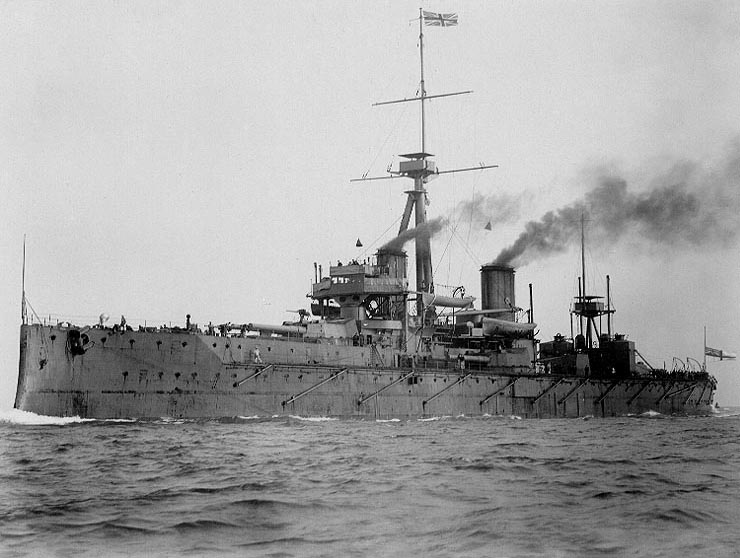
One. Well, there was a ship called the HMS Dreadnought that was (to the British people of the time), bigger than Avengers Endgame, Beyoncé, and a new Harry Potter book put together. It was the pride of England, and so naturally, the Dreadnought wasn’t exactly open to the public. But it was to the Emperor of Abyssinia.
Two. Now, you might have been wondering, “why the hell would anyone go to all this effort, no matter how good the bragging rights are?” Because, dear readers, there was some 1910s beef. Back in the day, the officers in the Navy of different ships were rivals and loved a good prank, and it seemed that the sailors of the HMS Dreadnought had a stick a little too far up, and the sailors of the HMS Hawke thought that they would do to be knocked down a few pegs. And guess what ship had an officer who was friends with Horace de Vere Cole?
So, onto the prank: some telegrams were sent ahead stating that the Emperor of Abyssinia desired to inspect the Dreadnought, and that he would be coming with his entourage. Horace impersonated a government official and arranged for them a VIP train carriage on the way to Weymouth, where the ship was docked. When they got there, they were given the whole nine yards; a band performance, crew salute, and the flying of a flag.
Now, here’s the interesting part. What language do they speak in Africa? Swahili. What language do 1910s British twenty-somethings not speak? Swahili. So, what they did they do instead? They spoke gibberish with the occasional Greek or Latin word thrown in, “translated” by Virginia’s brother, Adrian.
Another interesting development was the meal. A lovely meal had been prepared for the Emperor, but guess what doesn’t mix well with eating? Blackface and loose fake beards; so, they were forced to pretend as if something was wrong and not eat at all.
The final icing on the cake is possibly the greatest coincidence since the Civil War shot (a story for another time). It just so happened that Virginia and Adrian’s cousin, Willie, had a job in the Navy, and was a commander under the captain of the Dreadnought. And he didn’t recognize them. Now, this might not seem like such a big deal, but you have to understand something; Virginia Woolf was not impersonating an Abyssinian princess. She was impersonating a prince.
And so, the band of merry “royals,” left the Dreadnought and boarded a free carriage all the way back from London. But, that’s not where this story ends. Eventually, the public found out about this and the Navy was the laughingstock of the country. And so, with wounded pride, the Navy demanded Horace’s arrest. But Horace had an ace up his sleeve: he had broken not a single law.
And thus, he was home free, or so he thought. See, despite the captain loving the prank, apparently heavily armed soldiers don’t take kindly to having their pride wounded, so they decided to dish out some army style justice. They took Horace and his posse out to a field in the middle of London, and gave them (except for Virginia, because she was a lady), a good old fashioned spanking. With canes.
Thus ended the Abyssinian Royal Visit.
Now, in a way, you’d be stupid to believe me. Virginia Woolf is a respected author and how dare you slander her name? Oh yeah? Well take a look at this.